AI Adoption
What to Adopt — and Why
Today’s lecture
- 1Introduction
Exploring together, learning from each other, and active participation
- 2What changed?
Programming, mathematical reasoning, and research
- 3What remains human work?
Complexity, responsibility, and delegation
- 4AI adoption today
What developers use, delegate, and verify
- 5Course syllabus
Technical foundations and practical AI workflows
- 6Discussion
Your projects, skills, topics, and questions about AI
Exploring together
We will explore together
and learn from each other.
- Try tools on real tasks
- Share findings and failures
- Question, compare, and discuss
Grading
Active participation


What changed?
Programming, mathematical reasoning,
and research
From answers to iterative work
Conversation
Explain a bug
Suggest a proof strategy
Discuss a research paper
Produce an answer
+ Tool use
Run a test
Compute cases of a conjecture
Search and read sources
Act and obtain evidence
+ Feedback loop
Inspect a failed test → fix code
Find a counterexample → revise
Check the result again
Use results to choose the next action
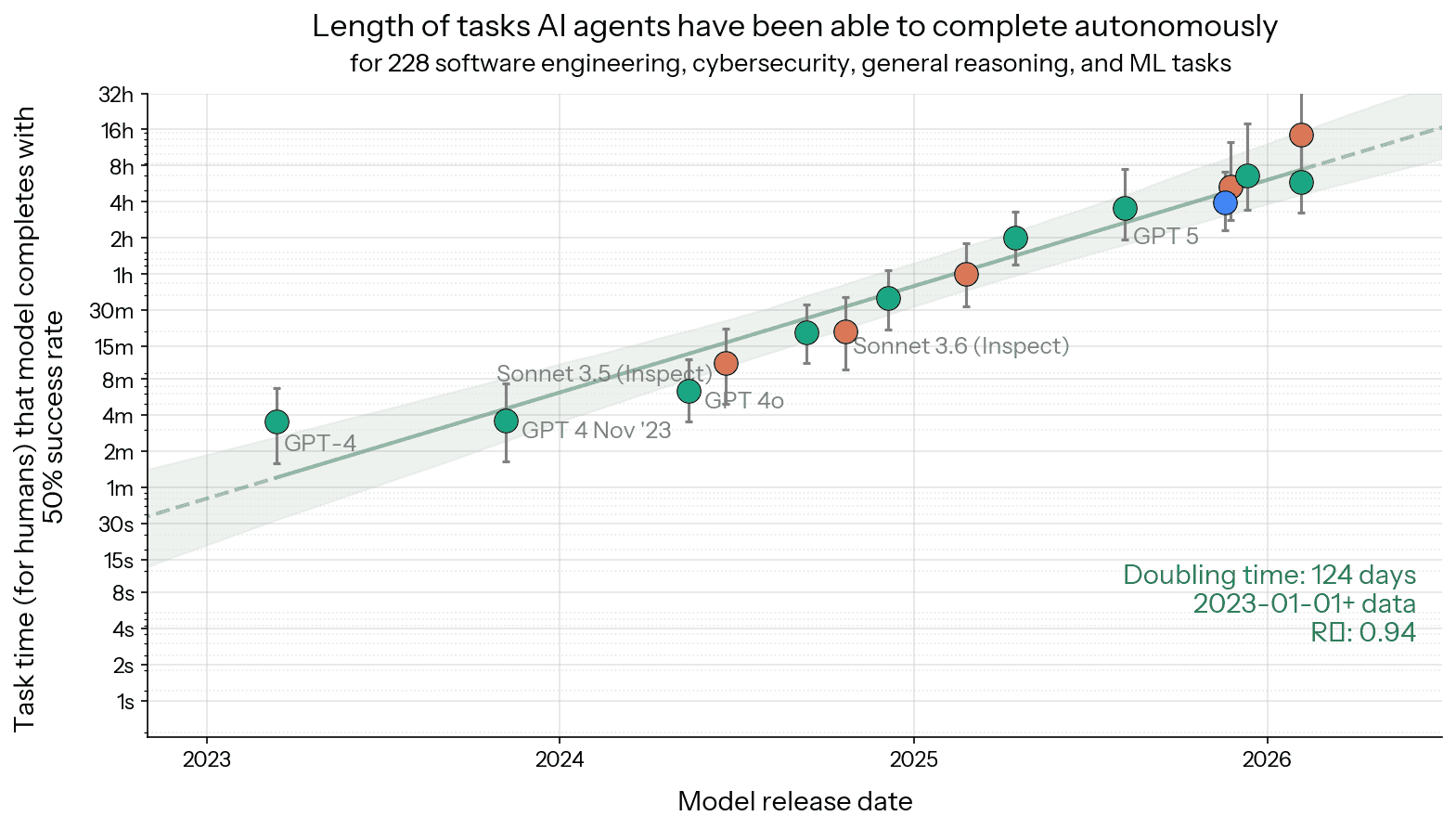
Agents can complete longer tasks

“75% of all new code at Google is now AI-generated and approved by engineers”
AI in mathematics
Problem-solving
AlphaGeometry
25/30 olympiad geometry problems
Neural proposals + symbolic deduction
AlphaProof + AlphaGeometry 2
IMO silver-medal standard · 28/42
Formal reasoning and geometry
Gemini Deep Think
IMO gold-medal standard · 35/42
Natural-language proofs
Research and verification
New results and conjectures
AI co-mathematician: exploration with humans
ProofCouncil: new bounds in Erdős #539
Aletheia / Erdős problems
Gemini Deep Think research agent
Four open questions solved in a 700-problem study
Fermat → Lean / Claude
Formalization of a known theorem
Largely autonomous work over 11 days
OpenAI: new mathematical results
manuscripts
OpenAI · Sharing AI progress in mathematics · October 6, 2026
What remains
human work?
Managing complexity and choosing
what to delegate
Engineering: Higher levels of abstraction
- AssemblyInstructions and registers
- CStructured programs
- JavaAutomatic memory management
- KotlinLess boilerplate
- Coding agentsDelegate implementation steps
Mathematics and research
Computer algebra
Delegate symbolic and numerical calculations
Proof assistants
Check formal derivations
Research agents
Delegate exploration, conjectures, and proof attempts
What remains human work?
- What’s always remained: break down problems, pick trade-offs, organise complexity
- Models may get much smarter, or they may not,
but human limits remain - Don’t find managing complexity interesting?
You will have to adapt! - But can’t agents just do it all?
They can, if you tell them what to do!
Andrey Breslav. Future of Programming: What’s our place in the world of coding machines?
June 2026
AI adoption today
What developers use, delegate,
and verify
AI is part of everyday work
of respondents use
AI tools at work
Tools currently used
Stack Overflow Developer Survey 2026 · Published October 6, 2026
n = 17,464 · Multiple answers allowed
Adoption differs by task
Share currently using AI for each task
Stack Overflow Developer Survey 2026 · Published October 6, 2026
n = 12,547
Trust depends on verification
Trust AI when they can
easily verify the output
Trust AI for many tasks,
including important decisions
Stack Overflow Developer Survey 2026 · Published October 6, 2026
n = 14,304 · Alternative answers to one question
Course syllabus
Technical foundations
and practical AI workflows
Understanding the systems
- 1
What to Adopt — and Why
Capabilities, delegation, human roles, final project
- 2
How LLMs work
Tokens, embeddings, Transformers, training, reasoning, multimodality, limits
- 3
Context, search, RAG, and memory
Knowledge in parameters, external sources, retrieval, context windows, persistence
- 4
How agents work
Models, tools, execution, planning, state, feedback, stopping conditions
- 5
Tools, APIs, and MCP
External services, plugins, skills, access permissions, prompt injection
- 6
The AI tool landscape
Assistants, research, documents, media, coding, automation, tool selection
- 7
Task formulation and context management
Goals, constraints, examples, acceptance criteria, iteration, decomposition, handoffs
Building reliable workflows
- 8
Research, learning, and information work
Papers, sources, documents, data, tutoring, independence, academic integrity
- 9
Working with coding agents
Investigation, task definition, planning, implementation, debugging, tests, review, autonomy
- 10
Configuring an agent for your tasks
Persistent instructions, project context, skills, MCP, hooks, state, environment
- 11
Checking AI results
Tests, evals, facts, calculations, expert review, LLM judges, errors, cost, time
- 12
Managing multiple agents
Dependencies, coordination, isolation, integration, parallelism, budgets, human attention
- 13
Adoption in workflows and teams
Pilots, process changes, responsibility, measurement, monitoring, scaling
Discussion
Your projects, skills, topics,
and questions about AI
Your interests and questions
- What would you like to build or investigate?
- What skills would you like to develop?
- What would you like to explore and share with the group?
- What AI-related questions are on your mind?