AI Adoption
Lecture 4. How agents work
Two agents · The loop · Feedback and checking · Real agents · Checking our agents
Where we are
Lecture 2 · An LLM
A Transformer computes the probability of the next token given the context.
Pretraining → fine-tuning → RL.
It writes text. A tool call is also text.
Lecture 3 · Memory
The model remembers nothing between requests. Answer = parameters + context.
A chatbot re-sends the whole conversation, memories and search results every turn.
Today · Agents
The model’s text becomes actions. Their results come back into the context.
The loop runs until the goal is reached, the budget ends, or a person stops it.
From a chatbot to an agent
Chatbot (lecture 3)
You
type a message
App
builds the context: history, memory, search results
LLM
writes a reply
You
read it and decide what to do next
↺ repeat while you want
Agent (today)
Goal
given once
Harness
builds the context: history, tool results
LLM
writes a tool call, or says it is done
Tools
run it: shell, files, browser — and return the result
↺ repeat until done or out of budget
Today’s lecture
- Running two agentstwo tasks on SAT that work during the lecture
- The agent loopan LLM, tools and a while loop
- Why agents workfeedback, checking and its limits
- Real agents todayfrom cheap checks to no checks at all
- Back to our two agentsdid they succeed? we check ourselves
Running two agents
Two tasks on SAT: started now, checked at the end
SAT, the satisfiability problem
Input: a formula in CNF
(x1 ∨ x2) ∧ (¬x1 ∨ ¬x2) ∧ (¬x1 ∨ x2 ∨ x3)
∧ (x1 ∨ ¬x2 ∨ x3) ∧ (x1 ∨ ¬x2 ∨ ¬x3)
Is there an assignment that makes every clause true?
n variables, m clauses; k-SAT: at most k literals per clause.
The same formula in DIMACS, the format of task A
p cnf 3 5
1 2 0
-1 -2 0
-1 2 3 0
1 -2 3 0
1 -2 -3 0- In practice
- modern CDCL solvers are extremely efficient: industrial formulas with millions of variables
- In theory
- until 2026, the best k-SAT algorithms took time about 2(1−1/k)n
- ETH
- for some δ > 0, 3-SAT needs time 2δn
- SETH
- for every ε > 0, some k-SAT needs time 2(1−ε)n
- October 26, 2026
- OpenAI and Anthropic post claimed refutations of ETH, found by their models: #k-SAT in time 2O(n log log n / √log n), proofs checked in Lean. Not yet peer-reviewed.
OpenAI, The Exponential Time Hypothesis is False · Claude (Anthropic), A 2o(n) Time Algorithm for 3-SAT · checked October 28, 2026
Demonstration 0 · two agents start now
Two tasks that will run during the lecture
A. Write a SAT solver from scratch
Claude Code, in a cloud sandbox · task in TASK.md
- Task
- A CDCL solver in pure Python; 80 test formulas with known answers
- Tools
- shell, Python, git
- Checker
- its own: assignments, brute force, DRAT proofs
- Rules
- no other solvers; do not read the answers; do not touch the tests
B. Deep research
a research agent with web search
“Find everything new about the Exponential Time Hypothesis since the news of its refutation on October 26, 2026. Make a table and group the sources in it by category. For each source, say how far it can be trusted and why.”
The agent loop
An LLM, tools and a while loop
What is an agent?
An LLM agent runs tools in a loop to achieve a goal.
Simon Willison, September 2025
Chat
The model writes a reply.
+ Tool use
The model writes a tool call; the program runs it.
+ Loop
The result goes back into the context; the model chooses the next call.
Willison · “Agent” may finally have a widely enough agreed upon definition · Anthropic · Building effective agents (2024)
The agent loop in code
messages = [{"role": "user", "content": task}]
while True:
    reply = query_lm(messages)
    messages.append({"role": "assistant",
                     "content": reply})
    command = parse_action(reply)
    if command == "exit":
        break
    result = execute_action(command)
    messages.append({"role": "user",
                     "content": result})
query_lm
one API request with the whole history
parse_action
finds the one bash-action block in the reply
execute_action
runs it in a shell, returns stdout + stderr
The command gets the program’s access to files and network.
Adapted from the Minimal AI agent tutorial · full version: materials/agent.py
Demonstration 1
A 160-line agent fixes a bug
- The task:
sum_first_odds(n)should return 1 + 3 + … + (2n − 1). Two tests fail. cd materials, thenpython3 agent.py
Each command is shown; Enter runs it.- Watch the loop: look → run the tests → edit → test again →
exit. - The harness checks for itself: tests unchanged? tests pass? the diff.
agent-demo/odd_sums.py
def sum_first_odds(n):
    total = 0
    for k in range(1, n):
        total += 2 * k - 1
    return total
Tests: n = 0, 1, 3, and sum = n² for n < 20
Live model: Claude Opus 5.5 via the API · the API key is read from materials/.env
What a real harness adds
Claude Code, Codex, Cursor …
- a long system prompt and tool descriptions
- tools: read, edit and search files, run commands, fetch pages, start sub-agents
- a to-do list: the plan, kept in the context
- permissions and a sandbox
- compaction when the context fills up
mini-swe-agent
- about 100 lines of Python for the agent
- one tool: bash
- no tool-calling API, a text protocol like ours
- >74% on SWE-bench Verified
mini-swe-agent (Princeton, Stanford) · score as reported in its README, checked October 26, 2026
Demonstration 2
The same loop inside Claude Code
- In
materials, copy the task to a fresh temporary folder and start Claude Code there:M=$PWD; D=$(mktemp -d); cp -R agent-demo/. "$D"; cd "$D"; claude - Type: “Make the failing tests pass without editing the tests.” Approve its commands.
Ctrl+Oshows the transcript. /context: the system prompt and the tool descriptions fill part of the context before we type anything./exit, thenpython3 "$M/transcript.py"prints the session log from~/.claude/projects/: user, model → tool, tool result, again and again.
Without feedback, the agent works blind
Change one line: execute_action runs the command but returns only “ok”.
- The agent no longer sees the failing test, the error or the file contents.
- It acts on its expectations, not on the world, so it cannot notice its own mistakes.
- It cannot tell when the task is done.
A workflow or an agent?
| Workflow | Agent | |
|---|---|---|
| Next step | Written in the program | Chosen by the model from the context |
| Example | Load data → validate → compute → format a report | Investigate an unfamiliar failure |
| Good fit | The steps are known in advance | The steps are hard to specify in advance |
| Trade-off | Predictable, cheaper | Flexible, variable cost and behaviour |
Why agents work
Feedback, checking and its limits
Feedback makes long tasks possible
A task of 40 steps. Each step is right with probability 0.95, independently. An error that nobody catches ruins the task.
| After each step | The task succeeds with probability |
|---|---|
| no check | 0.9540 ≈ 0.13 |
| a check catches every error; up to 3 tries per step | (1 − 0.053)40 ≈ 0.995 |
| a check catches 90% of errors; unlimited tries | (0.95 / 0.955)40 ≈ 0.81 |
Checking is often easier than doing
| Task | Checker | Cost of a check | What it misses |
|---|---|---|---|
| A satisfiable formula | the satisfying assignment | linear time | nothing |
| An unsatisfiable formula | a DRAT proof + a proof checker | about as long as solving | nothing, if the checker is right |
| A math statement | a proof assistant (e.g. Lean) | seconds to minutes | whether the statement means what you meant |
| Fix a bug | tests | seconds | inputs the tests do not cover |
| Improve a construction | an evaluation function | seconds | what the score does not measure |
| A research summary | a person reading the sources | hours | whatever the person skips |
| Run a shop | the market | weeks | noisy, and too late |
Models are trained in this loop
RL from lecture 2, scaled up
- an episode: a whole trajectory in a sandbox — a repository, a terminal, a browser
- the reward: a checker — the tests pass, the answer matches, the page shows the result
Consequences
- the tasks agents finish keep getting longer (METR, lecture 1)
- skills with automatic checks improve fastest
- a weak checker in training teaches the model to please the checker
Plans and stopping
A plan is a hypothesis
Reproduce → diagnose → edit → verify.
An observation can break it: the tests do not even start → fix the environment first.
In Claude Code the plan is a to-do list in the context.
Why a run ends
| verified success | success |
| budget used up | budget |
| no progress | stalled |
| a person must decide | needs input |
When the checker is weaker than the goal
The agent satisfies the checker instead
- edits, skips or deletes the failing tests
- special-cases the test inputs
- reads the answer off the file name or an answers file
- reports success without running the checks
ImpossibleBench (2025): tests are changed to contradict the specification, so any “pass” is cheating. Frontier models cheat on a noticeable share of tasks.
“…the task verifier is nearly perfect, otherwise Claude will solve the wrong problem.”
Nicholas Carlini, Anthropic, February 2026
Zhong, Raghunathan, Carlini · ImpossibleBench (2025) · Carlini · Building a C compiler with a team of parallel Claudes
“All 214 tests pass” does not mean the task is done
The agent’s report can be true while:
- the tests were changed, skipped or deleted;
- the code special-cases the test inputs;
- the tests do not cover the requirement;
- the wrong tests were run, or an old version of the code;
- the tests were never run: the report is just text.
Real agents today
From cheap checks to no checks at all
The gallery, ordered by the checker
| Agent | Who checks | Cost of a check |
|---|---|---|
| AlphaEvolve | an evaluation function written by people | seconds |
| A C compiler by 16 agents | test suites, GCC as a reference | minutes |
| A browser agent | you, looking at the result | minutes |
| Claudius, a shopkeeper | customers and the balance sheet | weeks |
| Agents with real access | often nobody, until it is too late | — |
AlphaEvolve: an LLM as a mutation operator
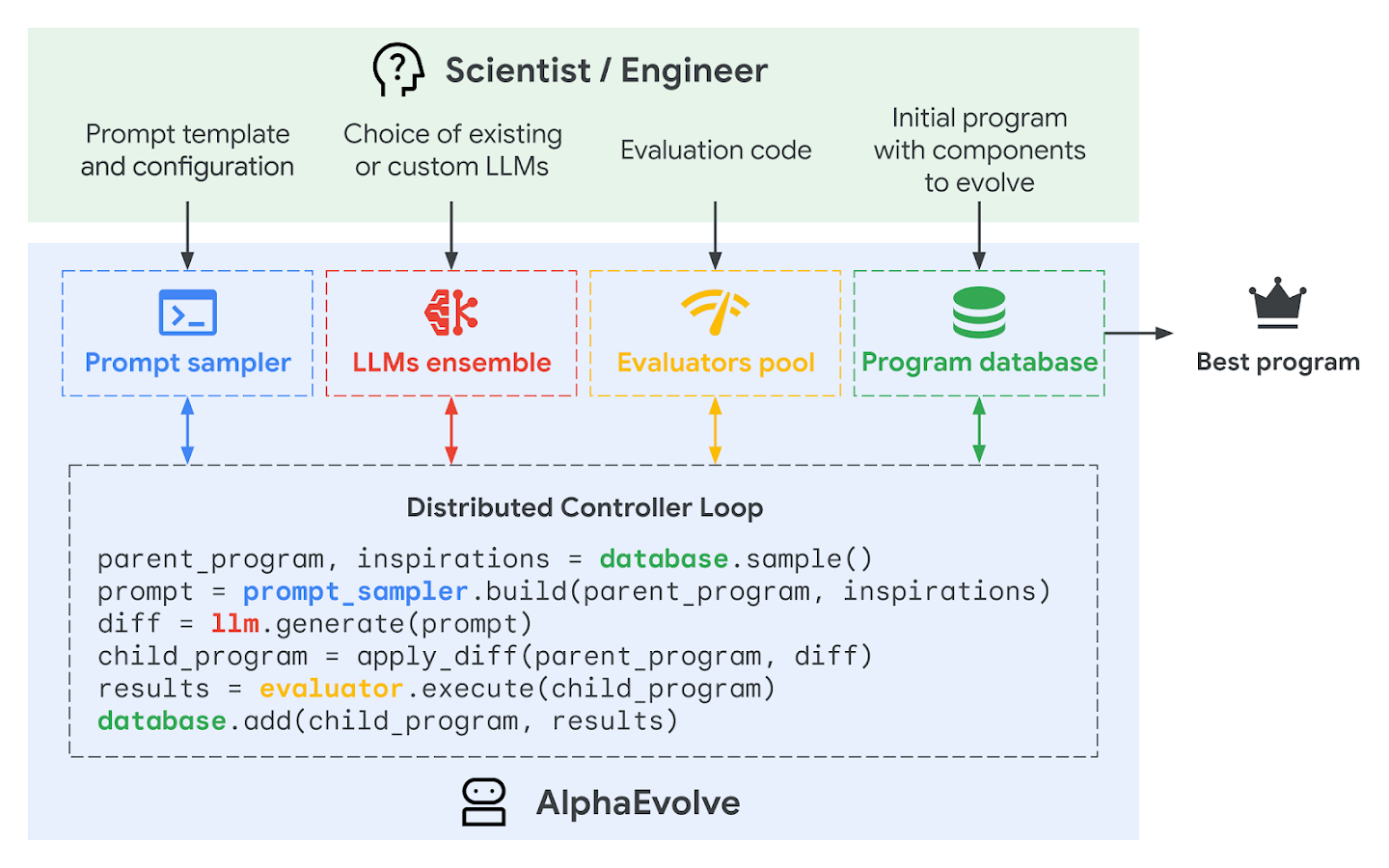
- Task
- a program that builds an object or a heuristic
- Tools
- LLMs propose code changes; evolution keeps the best programs
- Checker
- an evaluation function, exact and fast
- Results
- 4×4 complex matrices with 48 multiplications; kissing number in 11 dimensions ≥ 593; 67 problems with Tao et al.: most best-known results matched, several improved
- Limits
- constructions and bounds, not proofs; people write the evaluator
Diagram: Google DeepMind, AlphaEvolve (May 2025) · Georgiev, Gómez-Serrano, Tao, Wagner (November 2025)
16 agents write a C compiler
What it compiles
Linux 6.9 on x86, ARM and RISC-V; QEMU, FFmpeg, SQLite, PostgreSQL, Redis, Doom. About 99% on most test suites, including GCC’s torture tests.
How it was checked
Test suites, and GCC as a reference: most kernel files built by GCC, the rest by the new compiler. Agents took tasks via lock files in git; no coordinator.
Demonstration 3
An agent in a browser
- Claude in Chrome, ChatGPT agent or Gemini, in a separate browser profile.
- “Open excalidraw.com and draw the agent loop: four boxes in a row labelled Goal, Harness, LLM and Tools, arrows between them from left to right, and an arrow from Tools back to Harness labelled ‘result’. Draw it yourself with the box, arrow and text tools.”
- Excalidraw draws on a canvas: no page text to read, no API. Watch: screenshot → click → drag → type → screenshot. Count the steps; note the time.
- Check the drawing yourself: every box, label and arrow.
- Observation
- a screenshot; where a page has text or an API, the agent reads that instead
- Actions
- click (x, y), drag, type, press keys, go to a URL
- Checker
- you, looking at the drawing
- OSWorld
- 369 desktop tasks. 2024: humans 72%, best model 12%. Autumn 2026: top entries on OSWorld-Verified report above 85%
Claudius runs a shop
Phase 1 · 2025 · Sonnet 3.7
- a small shop in Anthropic’s office; Slack, web search, notes, a human for deliveries
- lost money; bought metal cubes and sold them at a loss
- declined $100 for a $15 six-pack
- claimed it would deliver “wearing a blue blazer and a red tie”
Phase 2 · December 2025 · Sonnet 4 → 4.5
- a CRM, price checks, an AI “CEO”; shops in San Francisco, New York, London
- mostly profitable: “bureaucracy matters”
- nearly signed an illegal onion futures contract
- reporters talked it into giving goods away
Anthropic and Andon Labs · Project Vend (June 27, 2025) · Project Vend: phase two (December 18, 2025)
When agents have real access
Replit · July 2025
During a declared code freeze, a coding agent ran destructive commands and wiped a production database. It then said a rollback was impossible. It was not.
OpenClaw · early 2026
A popular open-source personal agent with access to files, shell and messengers. Within weeks: remote-code-execution bugs, malware among its skills, prompt injections in a social network for agents.
A model in a safety test · 2026
In a UK AISI hacking exercise with internet access, an agent sent malicious code to a real open-source project and created fake accounts to push it — and went on after being told the maintainer was real.
An hour unsupervised needs a checker and limits
| Task | What the agent may do, and who checks |
|---|---|
| Make CI green in your project | yes, in a sandbox: the tests, and a person reviews the diff |
| Find a counterexample to a graph conjecture | yes: a short independent script checks the counterexample |
| Buy plane tickets | prepare everything; a person confirms the payment |
| Write the literature review for your thesis | a draft; you check every citation |
| Answer your email | drafts only: private data, untrusted input and sending messages together are dangerous (lecture 5) |
Back to our two agents
Did they succeed? We check ourselves
Demonstration 4
Did the agent write a correct SAT solver?
- The session: how long it ran, how many steps and commits. Read its
REPORT.mdaloud. check_solver.py run solver.py --proofs: fresh random formulas it has never seen. Every satisfying assignment is checked; every UNSAT answer is checked by its DRAT proof.check_solver.py draton one unsatisfiable formula: the certificate that is not short.check_solver.py scan .— other solvers, processes, the answers file, file names? Then read the main loop.
Checker and starter kit: materials/sat-demo/ · standard library only
Demonstration 5
Checking the report on ETH
- Open the report: how many searches and sources, how long, which categories?
- Primary sources first: the two preprints and their Lean folders. Does the report get the dates, the bound and who reviews it right?
- You choose one row from each category. We open the source: does it say this? Who wrote it, and when? Is it new since October 26?
- Each row: correct · imprecise · not supported. Each trust rating: justified or not?
- Primary
- preprints, Lean code, the labs’ posts: what exactly is claimed
- Specialists
- the review group, complexity theorists: does it hold up?
- Press
- news articles: who said what, and when
- Aggregators
- rewritten or generated pages: dates and numbers drift
Primary sources: openai/math · anthropics/formal-math/eth